




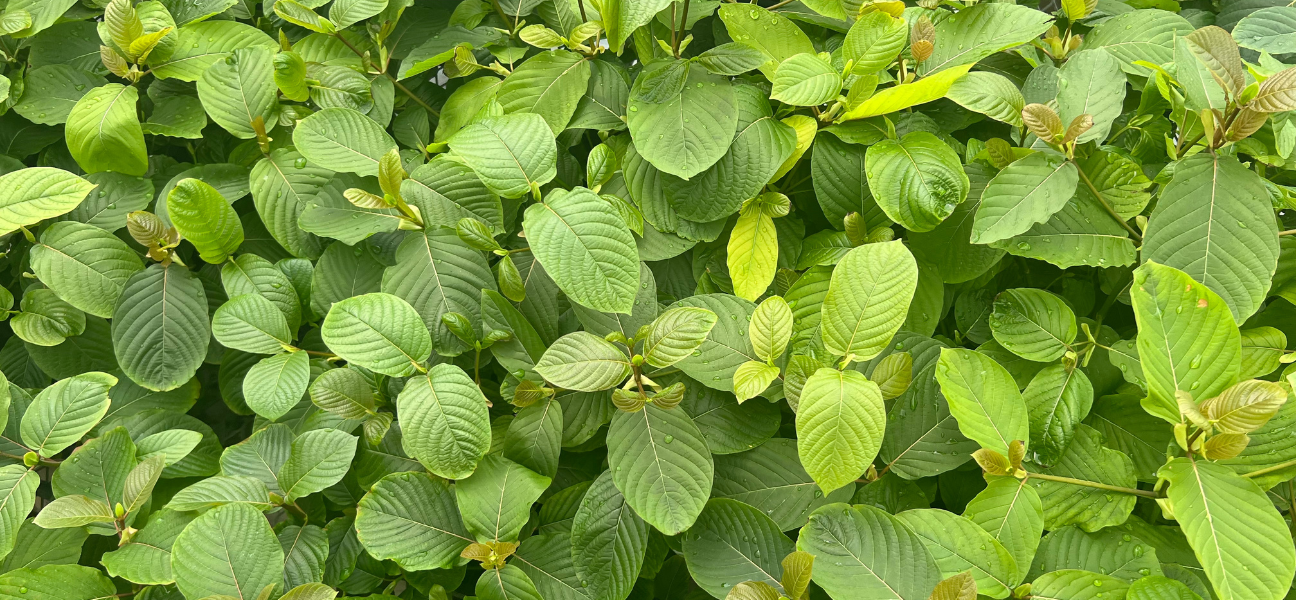
How to Make Kratom Tea & What ETHA’s Lab Experiment Taught Us

Kratom tea is one of the oldest and most traditional ways to enjoy Mitragyna speciosa. But traditional doesn’t have to mean boring.
With fresh kratom leaves, a few ingredients from your kitchen, and a little creativity, you can turn kratom into everything from a bright lemon-ginger tea to a tropical iced drink or even a creamy kratom chai.
And here’s something that makes the experience even more interesting:
You can grow the leaves yourself.
ETHA offers live kratom plants, allowing you to grow your own Mitragyna speciosa plant at home and experience this remarkable botanical literally from plant to cup.
So first, let’s make some tea.

3 Simple & Creative Kratom Leaf Tea Recipes
1. Lemon-Ginger Kratom Tea

Bright, warm, slightly spicy, and a great match for kratom’s naturally earthy flavor.
You’ll need:
- Kratom leaves
- Fresh ginger
- Lemon
- Honey
- Water
How to make it:
Heat water and steep your kratom leaves with several slices of fresh ginger for approximately 10–15 minutes.
Strain the tea, then add fresh lemon juice and honey to taste.
The ginger adds warmth while the lemon and honey help balance kratom’s naturally bitter, botanical flavor.
ETHA Tip: Keep that lemon handy. As you’ll see later, our laboratory experiment found an interesting reason why adding citrus may be useful when brewing kratom tea.
2. Tropical Pineapple-Mint Kratom Tea

Think tropical iced tea, with a kratom twist.
You’ll need:
- Kratom leaves
- Pineapple juice
- Fresh mint
- Lime
- Water
- Ice
How to make it:
Brew your kratom leaves in hot water and strain.
Allow the tea to cool slightly, then add pineapple juice, lightly crushed mint leaves, and a squeeze of fresh lime.
Pour over ice and enjoy.
The sweetness and acidity of pineapple paired with fresh mint can transform kratom’s earthy flavor into a refreshing tropical drink.
3. Kratom Chai Latte

If earthy teas are your thing, kratom and chai make a surprisingly natural combination.
You’ll need:
- Kratom leaves
- Chai tea
- Cinnamon
- Fresh ginger
- Milk, oat milk, or almond milk
- Honey or maple syrup
How to make it:
Steep your kratom leaves alongside chai tea, cinnamon, and a small piece of fresh ginger.
Strain, then add warmed milk or your favorite plant-based alternative.
Sweeten lightly with honey or maple syrup.
The cinnamon, chai spices, and creamy milk help soften kratom’s bitterness and turn it into something much closer to a café-style drink.
From Your Own Kratom Plant to Your Own Cup
One of the things we love about kratom is that it starts with something remarkably simple:
A leaf growing on a tree.
ETHA actually grows Mitragyna speciosa, studies the plant, and makes live kratom plants available to our customers.
That means you can grow your own kratom plant, learn about the botanical firsthand, and use its leaves to experiment with preparations like herbal tea.
For plant lovers, kratom enthusiasts, and people who simply want a closer connection to the botanicals they use, there is something special about going from:
Plant → Leaf → Tea → Cup.
But if you know ETHA, you probably know we weren't going to stop at simply making a cup of tea.
We wanted to know what was actually happening inside the tea.

Because We're ETHA… We Had to Test It
At ETHA, curiosity usually leads to an experiment.
We don't just work with Mitragyna speciosa. We study it.
Through ETHA Labs, outside laboratories, analytical testing, formulation work, and continued research, we're constantly trying to better understand the kratom plant and share what we learn with the ETHA community.
So when it came to kratom tea, we had a question:
How much of kratom's alkaloid content actually makes it from the leaf into the tea?
Kratom contains naturally occurring compounds called alkaloids, including mitragynine and numerous minor alkaloids.
If you place kratom leaves into hot water, how efficiently does the water pull those compounds out of the plant material?
And could something as simple as lemon juice change the results?
There was only one way to find out.
We tested it.

The ETHA Kratom Tea Experiment
We wanted to compare three preparations:
- Kratom plant material itself
- Kratom extracted into hot water
- Kratom extracted into hot water with lemon juice
The objective was to better understand how much of the measurable alkaloid content could be recovered in the liquid when making tea.
How We Prepared the Samples
All three samples came from the same batch of dried Green Vein kratom leaves.
The leaves were dried and ground into a fine powder so that the starting material would be consistent.
We divided the kratom into three equal 8.1-gram portions.
Sample 1: Kratom
8.1 grams of kratom powder with no tea preparation.
This provided our baseline for comparison.
Sample 2: Kratom + Hot Water
8.1 grams of kratom were added to 225 mL of purified water and heated to a boil.
Sample 3: Kratom + Hot Water + Lemon
8.1 grams of kratom were added to 225 mL of purified water, heated, and combined with 18.6 mL of lemon juice.
For the liquid preparations, we separated the tea from the remaining plant material using a centrifuge to minimize liquid loss and improve recovery.
The samples were then analyzed using High Performance Liquid Chromatography (HPLC) to measure alkaloids including mitragynine and 7-hydroxymitragynine.

So… What Happened?
Here's where things became interesting.
Plain Kratom Tea
Our experiment found that the hot-water tea recovered less measurable mitragynine than was present in the original kratom material.
Based on our testing, the plain-water preparation showed approximately a:
31% decrease in recovered mitragynine
compared with the original plant material.
In other words, hot water alone did not extract all of the measurable alkaloids from the kratom material into the tea.
Some remained behind in the plant material.
What Happened When We Added Lemon?
This was the fun part.
When lemon juice was included, the difference compared with the starting material was approximately:
16% instead of 31%.
That suggests that, under the conditions used in this particular experiment, adding lemon improved the recovery of mitragynine into the tea compared with hot water alone.
Why might this happen?
Weak acids such as citric acid are commonly used in botanical extraction, and changing the pH of the solution can influence the solubility and extraction behavior of certain plant compounds.
Which brings us back to Recipe #1.
There really was a reason we told you to keep that lemon nearby.
Does Boiling Water Destroy Kratom Alkaloids?
This is another question we hear frequently.
People sometimes assume that because the water is hot, boiling must immediately destroy kratom's alkaloids.
It isn't quite that simple.
Temperature, exposure time, pH, storage conditions, and the specific compound involved can all influence chemical stability.
In our tea experiment, however, the bigger issue wasn't simply that the water was "too hot."
The experiment demonstrated that not all of the alkaloids moved from the plant material into the water during brewing.
That's an important distinction.
If you want to take a conservative approach when brewing kratom tea, you can bring the water to temperature, remove it from direct heat, and allow it to cool slightly before steeping your leaves, similar to the way many traditional teas are prepared.
What Did ETHA Learn?
Our little cup of kratom tea ended up teaching us quite a bit.
***First, hot water alone did not extract all of the measurable mitragynine from the kratom material under our experimental conditions.
***Second, adding lemon improved alkaloid recovery in our experiment.
***And third, preparation matters.
The plant you start with, amount of plant material, water volume, temperature, steeping time, acidity, filtration method, and natural variation between kratom leaves can all affect the final cup.
This was one controlled ETHA experiment, not a declaration that every cup of kratom tea will produce exactly the same result.
And that's exactly why we experiment.
A Cup of Tea Can Lead to a Lot of Questions

That's part of what makes Mitragyna speciosa so fascinating.
You can grow the plant.
Pick its leaves.
Make a tea.
And then take that same tea into a laboratory and begin asking questions about what is actually happening chemically.
That's ETHA.
We believe better botanical products begin with better knowledge.
So we grow plants. We study plants. We test alkaloids. We formulate. We experiment. We send samples to laboratories. And sometimes we simply make a cup of tea and ask:
"What happens if we do this?"
Every experiment gives us another piece of the puzzle, and another opportunity to share what we've learned with you.
So whether you're making a warming lemon-ginger kratom tea, cooling down with a pineapple-mint version, experimenting with a creamy chai, or growing your very own ETHA kratom plant…
Stay curious.
Keep learning.
And
LIVE FULLY.™
This ETHA experiment represents the results of the specific materials, preparation methods, and testing conditions used. Natural botanical materials can vary, and results should not be interpreted as establishing the exact alkaloid content or effects of every kratom tea preparation.


Leave a comment